



A spiritual journeys in India
A Spiritually Enriching Journey Through India
A spiritual journeys in India
A spiritual journeys in India

A spiritual journeys in India
A spiritual journeys in India
Vrindavan · Varanasi · Rishikesh
The Himalayas
March Saturday 14th – April Saturday 4th, 2026 - FULLY BOOKED
Step into the sacred heart of India — a land where spirituality is not a practice, but a way of life. This carefully curated journey invites you to walk in the footsteps of sages, saints, and seekers, through locations that have inspired devotion and inner inquiry for thousands of years.
From the devotional rhythms of Vrindavan, the eternal chants along the Ganges in Varanasi, and the yogic sanctuary of Rishikesh, to the stillness and majesty of the Himalayas, this journey is designed to nourish the soul, awaken the mind, and reconnect you with deeper truths.
India is revered as the birthplace of profound spiritual traditions — including Yoga, Meditation, and Ayurveda — and as the cradle of philosophies that continue to guide humanity toward compassion, service, and self-realisation. For centuries, seekers from across the world have travelled to this mystical land, believing in its unique power to restore balance, clarity, and inner peace.
Journey Details
-
Total Cost: AUD $TBA per person for 2027
-
Single Supplement: AUD $TBA for 2027
-
Reservation: AUD $400 deposit secures your place
-
Group Size: Maximum 9 guests
-
Crew: 2 Nomadic Spirit Journeys team members + experienced camel wallahs during the desert safari
-
Limited places annually for this intimate and very special 2027 India journey
2026 celebrates our tenth shared journey in India — a heartfelt celebration of sacred places, ancient wisdom, and meaningful connection.
A spiritual journeys in India
A spiritual journeys in India

A spiritual journeys in India
A spiritual journeys in India
22 days in India provinces:
Uttar Pradesh and Uttarakhand
-
4 days in Vrindavan visiting the Sacred Kunds of Govardhan — hidden gems of devotion and bhakti.
-
5 days in Varanasi, the world’s oldest continuously inhabited city and India’s spiritual capital.
-
6 days in Rishikesh — gateway to the Himalayas and revered pilgrimage centre; Yoga Capital of the World.
-
2 nights on the banks of the Alaknanda River, immersed in the serenity of the Garhwal Himalaya.
-
1 night at Babaji Cave Farmstay, near Mahavatar Babaji’s sacred cave, revered as one of the most spiritually significant sites in the Himalayas.
Highlights
1. Guided throughout by Professor Anil Kumar Chaturvedi
-
A Sanskrit scholar and Varanasi-based guide, Professor Anil offers rare insight into India’s spiritual, historical, and living traditions. His grounding in Sanskrit provides authentic context to sacred sites, scriptures, and rituals encountered along the journey. (Read more about Professor Anil below.)
2. Sacred sites of Kriya Yoga
-
We visit Mahavatar Babaji’s Cave, where Babaji initiated Lahiri Mahasaya in 1861 — marking the birth of Kriya Yoga in this Dwapara Yuga. The Mahavatar Babaji cave is regarded the Most Spiritual Cave in Himalayan Region. We will two other significant caves in Uttarakhand.
-
We visit Devprayag which literally means ‘holy confluence’ as it is the place where two revered Indian rivers - Alaknanda and Bhagirathi - meet to form the holy Ganga. As per Hindu scriptures, Devprayag is an important holy confluence as this is where Bhagirathi, Alaknanda and Saraswati (the mythological river flowing underground) rivers meet. While Alaknanda originates from Badrinath, Bhagirathi originates from Gangotri.
-
There are five such prayags in Uttarakhand, each holding immense religious significance. These are Devprayag, Vishnuprayag, Nandaprayag, Karnaprayag and Rudraprayag and, together, these are known as the Panch Prayag. We will visit at least two prayags in Uttarakhand.
3. Immersion in India’s spiritual heartlands
-
From Vrindavan and Varanasi to Rishikesh and the Garhwal Himalaya, this journey follows India’s most revered pilgrimage and yogic landscapes.
Recommended Reading
A spiritual journeys in India
A spiritual journeys in India
A spiritual journeys in India
A spiritual journeys in India
Professor Anil will accompany the journey for the full 22 days
Meet our guide Professor Anil, and driver Nathu Ram at the Airport, or your accommodation for transfer to Vrindavan, a 3-hour drive from Delhi via the Yamuna Expressway.
Living in Varanasi with his wife and children, Anil is a Sanskrit scholar, multilingual guide, and cultural educator with many years of experience studying ancient texts, astrology, and the living traditions of India. More importantly, he brings a steady, thoughtful presence that gently supports travellers who are not only exploring the country, but also seeking deeper personal reflection along the way.
Rather than simply delivering information, Anil helps make sense of what we encounter — the rituals, the histories, the human stories and quiet meanings behind what unfolds around us. His explanations are clear, grounded, and unpretentious, allowing each person to take in as much as feels right for them. For many, the journey through India stirs reflection on life stages, choices, identity, and direction; Anil’s calm guidance offers space for both understanding the places we visit and quietly deepening one’s own inner perspective.
He communicates with warmth and clarity, helping travellers feel at ease in environments that can sometimes feel intense or unfamiliar. His reliability and experience have led to him being entrusted with guiding people from many backgrounds, including assisting during the official visit of President Emmanuel Macron and Prime Minister Narendra Modi to Varanasi — a reflection not of ego, but of professional respect and trust in his character.
Guests can expect Professor Anil to walk alongside them — informative when needed, reassuring when helpful, and always respectful — supporting both an enriching travel experience and the quiet personal insights that naturally arise throughout the journey.
A spiritual journeys in India
A spiritual journeys in India

A spiritual journeys in India
A spiritual journeys in India

A spiritual journeys in India
A spiritual journeys in India
Arrive in Delhi Terminal 3 -
Indira Gandhi International Airport
Transfer from New Delhi -
Vrindavan in Uttar Pradesh
Days 1-5: 14th-18th March
Vrindavan is one of India’s most significant pilgrimage towns, known for its long association with the stories of Krishna, Radha and the devotional traditions that have grown around them for centuries. It is a place where daily life, prayer and ritual continue side by side, giving visitors a chance to observe how spirituality is woven into ordinary routines rather than separated from them.
Rather than being defined by one central monument, Vrindavan is made up of many small sacred places — temples, ghats, pathways and neighbourhood shrines — that together form a living religious landscape. Walking through the town offers an opportunity to see how devotion is expressed in different ways, from formal worship to simple acts of offering and remembrance.
Among the most important sites in Vrindavan are the sacred kunds, or holy water bodies. These are traditionally associated with events from Krishna’s life and with figures such as Radha and the gopis. Radha Kund and Shyam Kund are the most widely revered, while others such as Kusum Sarovar, Man Sarovar and Prem Sarovar are visited for quiet prayer, reflection and time away from the busier temple areas. The kunds continue to be used by pilgrims today and form an important part of Vrindavan’s religious geography.
We stay at the MVT Guesthouse in Vrindavan, a well-established accommodation created for visitors who come for pilgrimage and spiritual study. It offers a calm, orderly and secure environment within easy reach of the town’s main sacred sites, making it a practical and comfortable base during our stay.
With Professor Anil accompanying the group, guests have the benefit of a guide who understands both the classical traditions and the everyday practices of Indian spiritual life. His role is to help explain what we are seeing and hearing, whether that is a temple ritual, a story connected to a kund, or the broader cultural context of Vrindavan itself. This allows people to engage with the place at their own pace and in their own way, whether they are interested in history, culture, religion or personal reflection.
Our days in Vrindavan are designed to give space to explore, observe and learn, rather than to follow a fixed spiritual script.
A spiritual journeys in India

A spiritual journeys in India
A spiritual journeys in India
Journey from Vrindavan to the Old City of Varanasi via Agra — By Train, Taxi and Rickshaw
Days 5-11: 18th-24th March
We leave Vrindavan early in the morning by taxi for Agra, then continue by train across northern India to Varanasi. On arrival, we transfer again by taxi before entering the Old City by rickshaw, weaving through the narrow, centuries-old lanes that lead down toward Ma Ganga, the mighty river known as the Ganges, and the ghats. This final stretch can only be navigated by someone who knows the area well, and it offers a first glimpse of the scale, density and living history of one of the world’s oldest continuously inhabited cities.
Varanasi
Varanasi is older than history, older than tradition, older even than legend, and looks twice as old as all of them put together.
Mark Twain
Also known as Kashi and Banaras, Varanasi is one of the world’s oldest continuously inhabited cities, resting on the western bank of Ma Ganga, the mighty river known as the Ganges. For more than three thousand years it has been a centre of learning, spiritual life, trade and pilgrimage, drawing people from every corner of India who come here to pray, study, bathe in the river, and honour the cycles of life.
In Hindu tradition, Varanasi is the city of Shiva — a place believed to sit at the centre of spiritual geography. It has long been regarded as a crossing point between the material and spiritual worlds, and for centuries people have travelled here to seek blessing, understanding, and, in some cases, to spend their final days beside the sacred river.
The Old City unfolds as a dense and ancient labyrinth. Narrow lanes twist between temples, homes, workshops, silk shops, food stalls and hidden shrines, slowly leading toward the river and the ghats. The city moves on foot, by bicycle, by rickshaw, and by memory — shaped by generations who have lived and worked in these same streets. The soundscape is layered: bells, voices, prayer, music, commerce, cooking, laughter, and the low, constant murmur of Ma Ganga nearby.
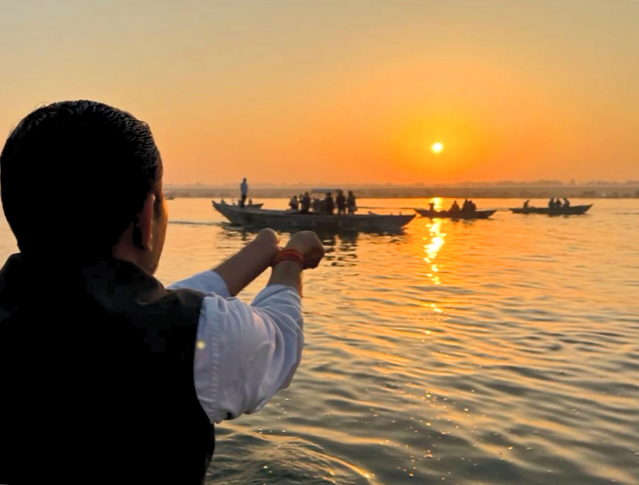
Along the ghats, daily life and ritual exist side by side. People come to bathe in the river, offer prayers, wash clothing, sit in silence, or simply watch the water move. Boats drift past carrying pilgrims, priests and families. A little further along, funeral pyres burn at the cremation ghats, continuing a tradition that has taken place here for centuries. In Varanasi, death is not hidden — it is understood as part of the same sacred rhythm as birth, worship and daily work.
At sunrise, the river is often at its most gentle. Pilgrims step into the water for their morning ablutions while priests chant and the first lamps are lit. In the evenings, the city gathers again for the Ganga aarti, when fire, movement and sound draw people together along the riverbank in a shared act of devotion to Ma Ganga.
Varanasi has also long been a centre of knowledge and culture. It is associated with Sanskrit learning, philosophy, music, silk weaving and literature, and was already ancient when the Buddha gave his first sermon nearby at Sarnath. Temples, ashrams, schools and family workshops sit side by side, reflecting the many ways spiritual and everyday life continue to interweave here.
Professor Anil knows Varanasi as both scholar and resident. Having studied here and lived much of his life in the city, he brings a grounded, personal connection to the places we walk through. His understanding of Sanskrit, history and living tradition helps give context to what we see — whether it is a small roadside shrine, a temple ritual, a stretch of ghats, or the rhythm of daily life along the river.
Varanasi is not something to be consumed or completed. It is a city that reveals itself gradually, through walking, observing, listening and being present — shaped by Ma Ganga, by centuries of devotion, and by the people who continue to live and pray along her banks.
A spiritual journeys in India
A spiritual journeys in India

A spiritual journeys in India
A spiritual journeys in India
Journey from the Old City of Varanasi to Rishikesh, Uttarakhand —
By rickshaw, taxi, and two flights (Varanasi–Delhi; Delhi–Dehradun)
Days Days 11-16: 24th-29th March
Rishikesh
We depart Varanasi on the morning of 24 March, flying first to Delhi and then onward to Dehradun in the state of Uttarakhand. From Dehradun, we continue by road to Rishikesh onwards to Upper Tapovan and our guesthouse.
Rishikesh occupies a distinctive place in India’s spiritual geography. Situated on the banks of Ma Ganga, the mighty river known as the Ganges, it has for centuries been associated with yogic discipline, scriptural study, pilgrimage, and retreat. Long before its emergence as an international centre for yoga, Rishikesh was known as a place where sages and householders lived side by side, drawn by the river and the surrounding Himalayan foothills.
References to Rishikesh appear in early Hindu texts and epics, where the region is described as a place of tapasya — sustained practice and discipline. It is traditionally associated with figures such as Rishi Raibhya and Sage Kubzha, and later became a centre for Vedantic learning, meditation, and ascetic life. Over time, ashrams, temples, and learning centres developed along the river, establishing Rishikesh as a place where spiritual instruction was lived rather than formalised.
Our accommodation during this part of the journey is a guesthouse located in Upper Tapovan, a beautiful area of Rishikesh. It provides a grounded, comfortable base while we move through different parts of the town and its surrounds during our stay. The guesthouse offers shared spaces suitable for rest, meeting as a group, and preparing for daily activities.
Rishikesh continues to function as both a town and a place of pilgrimage. Ashrams, temples, residential neighbourhoods, ghats, schools, and small businesses exist alongside one another, reflecting the way spiritual life and everyday life remain closely interwoven here. The river plays a central role in daily routines, religious observance, and seasonal festivals, and remains a constant presence throughout the town.
Our time in Rishikesh allows for visits to significant sites connected to it's spiritual history, time spent along the river, and observation of practices that continue to shape daily life. The town has also been a meeting point for Indian and international teachers, musicians, and students since the mid-twentieth century, contributing to its layered cultural and spiritual identity.
Professor Anil accompanies the group during our stay in Rishikesh. With his background in Sanskrit, Indian philosophy, and lived experience across northern India, he provides context for the places we visit and the traditions we encounter. His role is not instructional in a prescriptive sense, but explanatory — helping to situate Rishikesh within the broader arc of India’s spiritual history and within the journey that has already taken us through Vrindavan and Varanasi.
Loren and Karen Jane will offer Iyengar-style asana sessions during our time here. These sessions are optional and are offered as a continuation of embodied practice within the context of the journey.
Rishikesh also serves as an important point of transition. From here, the journey continues further north into Uttarakhand, following routes long travelled by pilgrims and practitioners moving between river confluences, mountain settlements, and sites of spiritual significance. Our days in Rishikesh provide continuity between the sacred river culture of Varanasi and the Himalayan pilgrimage landscape that follows.
A spiritual journeys in India
A spiritual journeys in India

A spiritual journeys in India
A spiritual journeys in India
Journey North from Rishikesh into the Garhwal Himalaya
Days 16–20: 29th March – 2nd April
On 29th March, we travel north from Rishikesh into the Garhwal Himalaya, following routes that have long carried pilgrims, householders and wandering ascetics into the mountain valleys of Uttarakhand. This part of the journey continues the same attentive pace established earlier — shaped by movement through place rather than by schedule — as the landscape gradually shifts from river town to forested hills and widening horizons.
The road traces Ma Ganga and her tributaries upstream, passing through valleys where rivers, settlements and temples have developed side by side for centuries. As elevation increases, the environment becomes more spacious and less densely inhabited, allowing the journey to unfold with fewer interruptions and a stronger sense of continuity between land, water and daily life.
River Lodge located near Rudraprayag
We spend the night of 29th March at a River Lodge, located near Rudraprayag on the banks of the river. Set within a quiet Himalayan valley, the lodge offers simple, comfortable accommodation in close relationship with the surrounding landscape. The presence of flowing water, open sky and mountain air provides a steady backdrop for rest and reflection at the end of the day.
Devprayag, the sacred confluence where the Alaknanda and Bhagirathi Rivers
Along the way, we visit Devprayag, the sacred confluence where the Alaknanda and Bhagirathi rivers meet to formally become Ma Ganga, the mighty river known as the Ganges. Long regarded as the most significant of the Panch Prayag, this meeting point continues to draw pilgrims who come to observe, pray, or simply stand at the joining of two distinct river currents — a place where geography and spiritual meaning have remained closely linked over time.
Rudraprayag, where the Alaknanda meets the Mandakini River
We also pass through Rudraprayag, where the Alaknanda meets the Mandakini River. The town takes its name from Lord Shiva in his Rudra aspect, and the surrounding valley reflects the long-standing relationship between river confluences and devotional life in the region.
During this northern journey, we visit Dhari Devi Temple, positioned above the river and regarded as a guardian shrine by local communities. The temple’s location reflects how spiritual sites in the Himalaya are often embedded directly within the landscape rather than set apart from it.
In the Dwarahat region, we visit Dunagiri Temple, set among forested ridges with wide views across the surrounding hills. The temple is associated with several strands of Indian tradition, including stories linked to the Ramayana and the Pandavas, and is also referenced in the Manas Khand of the Skanda Purana as Mahamaya Harpriya. The surrounding area continues to be known for medicinal plants and a long history of pilgrimage and retreat.
Village Farmstay in the Kumaon Himalayas
We stay for one night at Dwarahat Village Farmstay, with a family, in the Kumaon Himalayas near Babaji’s Cave. Meals are prepared in the home by the women of the household. We arrive with enough time to settle in before the evening. After breakfast the following morning, we depart in an unhurried way for our visit to Maha Avatar Babaji’s Cave.
Mahavatar Babaji’s Cave — Kukuchina, near Dwarahat
At the centre of our time in the Garhwal Himalaya is our visit to Mahavatar Babaji’s Cave.
Located near the village of Kukuchina. Within the Kriya Yoga lineage, this site represents a point of continuity — connecting the teachings and living traditions encountered in Varanasi with their Himalayan context.
The cave is traditionally associated with Mahavatar Babaji, described in Autobiography of a Yogi as the reviver of Kriya Yoga in the modern era. It is here that Babaji is said to have initiated Lahiri Mahasaya in 1861, giving rise to a lineage later carried forward by Sri Yukteswar Giri and Paramahansa Yogananda.
The approach to the cave is made on foot along a forested hillside path. The cave itself is modest and unadorned, set into the landscape rather than distinguished from it. Its simplicity stands in quiet contrast to the global reach of the teachings associated with it.
Our time here is unstructured and unprescribed. There is space to walk, sit, observe or remain still, allowing each person to meet the place in their own way. Nearby shrines and natural springs reflect the long-standing view of this area as a place of retreat rather than congregation.
This visit forms a natural point of gathering within the journey — where earlier devotional landscapes, city life and river culture meet the steadier rhythms of the mountains — without marking an endpoint or conclusion.
Vasishtha’s Cave
A Place of Stillness and Lineage
Before returning south, we visit Vasishtha’s Cave, traditionally associated with the Sage Vasishtha, one of the most revered figures in the Vedic tradition. Situated beside Ma Ganga and set back from roads and settlements, the cave has long been regarded as a place of contemplation.
Vasishtha is remembered not only as a seer, but as a teacher and householder — a figure who embodied wisdom within the responsibilities of worldly life. His association with this cave reflects a long-standing understanding within Indian tradition: that insight and steadiness are cultivated through presence and discipline rather than withdrawal from life altogether.
Our visit here is unstructured. Time is allowed simply to be in the space — to sit quietly, walk along the river, or observe the surroundings. For many, the cave offers a counterpoint to the density and intensity of earlier environments, reinforcing the through-line of the journey: learning through proximity to place, rather than explanation.
Return to Rishikesh
On 2nd April, we return to Anju's guesthouse in Rishikesh, arriving in the early evening. Returning to familiar surroundings after time in the mountains provides a gentle transition, allowing experiences gathered across riverbanks, temples and hill paths to settle naturally before the final days of the journey.
A spiritual journeys in India
A spiritual journeys in India

A spiritual journeys in India
A spiritual journeys in India
Journey from Garhwal Himalaya to Rishikesh, Upper Tapovan Homestay
Days 20-22: 2nd April – 4th April
On 2nd April, we return south from the Garhwal Himalaya to Rishikesh, arriving in the early evening at Anju’s guesthouse in Upper Tapovan. The return marks a natural easing of pace after time spent moving through river confluences, forested hills, and mountain settlements.
The final days of the journey are intentionally open. Time is available for further exploration of Rishikesh, for revisiting places encountered earlier in the stay, and for attending to practical needs such as shopping for textiles, books, musical instruments, or items connected with personal practice. For those who wish, there is also space simply to rest, walk along the river, or remain close to the guesthouse.
These concluding days allow experiences gathered across the journey — from Vrindavan and Varanasi through the Himalayan valleys — to settle without being hurried toward resolution or interpretation. The rhythm remains unforced, providing continuity rather than closure.
On 4th April, transfers are arranged to Dehradun Airport for onward travel to Delhi and departure home, or for those continuing onward with further travel plans.

What Is Included in the Tour Cost
• All accommodation as outlined in the itinerary
• Internal flights within India as specified
• Railway journey as outlined in the itinerary, and all taxi's, tuk tuk and rickshaw rides.
• All ground transport throughout the journey, including 5 day charter vehicle into Garhwal Himalaya & return
• Travel throughout India accompanied by Professor and guide Anil Kumar Chaturvedi
Guiding
Professor Anil is a Sanskrit scholar and experienced guide based in Varanasi who accompanies the group for the full duration of the journey, offering contextual understanding of sites, traditions, and daily life as we move through different regions. He will share all travels, meals and accommodations with our group. Many guests forward their personal information for Professor Anil to create their unique Astrological Chart, which he will interpret and allow for one-on-one time spent with each guest choosing this optional extra.
• Guidance and logistical support from the Nomadic Spirit Journeys team as well as input from other guides
Meals
Meals are a personal choice on this journey and are not included in the tour cost. This approach allows each traveller the flexibility to choose where, when and what they want eat according to appetite, dietary preferences, and daily rhythm. Dining in India is generally very affordable, and this arrangement has worked well on previous journeys, giving guests the freedom to explore local cafés and restaurants at their own pace outside the days set programming.
Activities and Daily Flow
The journey focuses on key cities, pilgrimage centres, and landscapes where much of the experience is open and accessible. Ghats, riverbanks, old city areas, village settings, and many sacred sites do not require entry fees and are open to the public.
Each evening, the following day’s plan will be shared, with a brief check-in again in the morning to confirm timings and logistics. This provides clarity while allowing the program to respond to local conditions, travel timing, and group needs.
Most temples & sacred sites customarily invite a small donation of one’s choosing or an offering such as flowers or a coconut. These offerings are optional and form part of local practice rather than a requirement. Items are usually available for purchase near temple entrances. Many temples, ghats, and public sites are freely open.
Yoga instruction with Loren Barker and Karen Jane Ellis will be offered wherever a suitable space or shala with mats is available. Participation is optional and guests are welcome to arrive with their own yoga mat.
What Is Not Included
• International flights to and from India
• Indian visa application fees
• Personal travel and health insurance
• Personal expenses such as alcoholic drinks, laundry, telephone calls, and incidental purchases
• Activities or excursions not listed in the itinerary - site fees to those with charges should this occur
• Excess baggage charges
• Emergency or medical expenses
• Any increase in costs beyond our control, including fuel surcharges, airfare increases, or additional government levies or taxes
While the itinerary is carefully planned, any unavoidable changes required during the journey due to circumstances beyond our control (such as weather or transport disruptions) are not included in the tour cost. Such situations are uncommon, and alternative arrangements would be discussed with guests at the time if required.
Before You Go — Please Remember To:
• Review the packing list
• Obtain your Indian visa
• Email Camel Treks Australia with your international flight arrival and departure details
• Complete the online medical waiver form
• Print a copy of your medical waiver to carry with you
• Carry printed copies of your passport for hotel check-ins
• Notify your bank that you will be travelling overseas
• Register with Smart Traveller
• Obtain comprehensive travel and health insurance and email Nomadic Spirit Journeys with your policy details
• Visit your doctor or a specialised travel doctor prior to departure
A spiritual journeys in India